Congrats to Making Our Way for selling his car on Ebay.
Of course, the first thing I did was check whether anyone was selling a Mercedes Benz SLR McLaren on Ebay. Turns it they were!!
The cheapest one is only $349,000.


Congrats to Making Our Way for selling his car on Ebay.
Of course, the first thing I did was check whether anyone was selling a Mercedes Benz SLR McLaren on Ebay. Turns it they were!!
The cheapest one is only $349,000.
I got email from a real estate agent yesterday outlining the numbers for a 4-plex in Texas. He did a great job of putting the numbers in a spreadsheet and then creating an image, which he then embedded into the email itself. This saved a lot of time and I’m sure resulted in a lot more of his investors actually looking at it right then, as opposed to filing it away for a later viewing only to forget it.
The only problem was the numbers were off. Instead of calculating a 2.5 or 2.75% tax rate, he calculated 1.35% tax rate. There was also no vacancy factored it. When using property management, there is usually a leasing fee, which can range from 50%-100% of the frist months rent. This is above the 8-10% property management fee, which was also conveniently set to 0%. I don’t know if this was deliberate but when you’re running the numbers these sort of errors will throw you off.
After fixing these errors, the $997/mo cashflow became $52/mo and the Cash-on-cash dropped from 37% to 1.97%!!! This kind of mistake will KILL your investment strategy.
If you don’t know how to do this kind of simple calculation, your real estate career will be sort lived!!! [I strongly recommend What Every Real Estate Investor Needs to Know about Cash Flow… And 36 Other Key Financial Measures
Trust but verify!

Mercedes Benz has come out with a really sweet roadster. Its a 600 hp, V8 2 seater that cost about $400,000. This car is worth more than my condo!! Here’s a picture of Paris Hilton getting out of it. Note the fancy gull-wing doors. Sweet!

From my previous posts, you can tell I’m losing money being short on a stock that is defying all expectations and has gone up 20% since the day I jumped in. I’ll admit, I’m not too bright and always forget to follow advice which I know to be true. Here’s a strategy that I should try and remember well.
My Strategy for Successful Short Selling
by Jeff ClarkWhen I first started trading stocks, I did so almost exclusively from the long side… only buying stocks.
Through a series of trials and errors, I developed a three-pronged approach for what constituted a good stock to buy:
1. Ridiculously cheap valuation.
2. High degree of pessimism surrounding the shares.
3. Price action that had just turned up following a long decline.As simple as this buying strategy might seem, it has produced superior returns… and it’s the strategy we follow in the Big Trend Report .
Logically, then, it makes sense to use a similar three-pronged approach to betting on a stock falling – called shorting.
1. Ridiculously high valuation.
2. High degree of optimism surrounding the shares.
3. Price action that has just turned down following a steady incline or parabolic rise.Let’s look at each element individually…
1. Ridiculously high valuation.
We all understand that, ultimately, earnings drive stock prices. Consequently, the P/E (price/earnings) ratio is the best gauge with which to measure the ridiculousness of a stock’s valuation.
If you’ve found stock with a P/E ratio 50% higher than the industry average, or more than 50% higher than the company’s historic P/E ratio, then you might have a good short sale on your hands.
2. High degree of optimism surrounding the shares.If every analyst on Wall Street loves the stock… If the anchors on CNBC seem to be mentioning the stock every hour… If all of your friends are talking about the fortunes to be made by owning the stock… Then it’s probably on my list of short sale candidates.
This concept is easy to understand. If the whole world is in love with a stock, and if everyone who wants to own the stock already does, then who is left to push the price higher? If there’s no one left to buy and to push the stock higher, then it only takes one seller to shift the momentum in the other direction.
3. Price action that has just turned down following a period of steady incline or parabolic rise.
Just as it doesn’t make much sense to jump in front of a moving train, it doesn’t make much sense to short a stock as it’s moving higher.
Rather than trying to pick a top in a stock, it makes far more sense to wait until the price action has turned lower – and in the early stages of a downtrend. For me, that confirmation occurs when the stock trades below its 50-day moving average.
Stocks in which the upside momentum is strong will hold above their 50-day moving average lines. Failing to hold above that line is an excellent early indication the momentum is shifting to the bearish camp.
You see, all of the Wall Street hype, all of the CNBC promotion, and all of the persuasive opinions of friends at cocktail parties creates big opportunities for us to bet against over-hyped stocks.
If you stick with these three guidelines, you’ll have all the tools you need to make money on the short side of the stock market.
Best Regards & Good Trading,
Jeff
WCI failed all three tests, its already dropped signficantly and there’s a tremendous amount of pessimism surrounding the stock. I should’ve stayed away! I’m not cut out to trade, which is why I got into real estate in the first place. Like my friend who’s a financial planner says, “Stick with what you know!”.
I guess times are tough in the Bay Area. Atleast for Pulte Homes who’s giving away $99,000 incentives if you purchase a home and can close before December 24th, 2006.
Some of the incentives include
* Rolled back pricing
* 100% financing
* Free pool
* No payments for 6 months
* No closing costs
* Free backyard landscaping
* Free window coverings
* Below market interest rates
* No HOA dues for 2 years
* Free Upgrades
& a Free vacation [includes airfair and & 7 night stay] for 2!
Someone sounds desperate to me.
Pity WCI isn’t showing similar weakness. The stock is up 20% from when I bought the puts. Just like I said, all the negative information pushed the stock up. Their cash is 94% less than it was last year and they’ve announced a share buy-back program! Sounds bogus to me. Anyway I bought more puts today.
Here’s a very interesting article on the builders at Rebalancing.blogspot.com
On the worst end you have WCI, with a rapid deterioration of their cash position (93% lower than a year ago), a 461% increase in Q2 borrowings (to $217.8 million) and $43,580,000 spent on share repurchases last quarter. They face huge problems with about half of their revenues historically coming from Florida condo sales and the story is being told in their cash flow statements. Perhaps they are repurchasing shares because they are dumb enough to think their stock is a bargain right now. Perhaps they just want to prop up the share price long enough for insiders to cash out before the collapse.
Here’s a must read article from BusinessWeek on Nightmare Loans.
Jennifer and Eric Hinz of Somerset, Wis., are feeling the squeeze. They refinanced out of a 5.25% fixed-rate, 30-year loan in June, 2005, and into an option ARM with a 1% teaser rate from Indymac Bank. The $1,483 payment for their original mortgage dropped to as low as $747 with the new option ARM. They say they had no idea when they signed up, however, that the low payment adds $600 in deferred interest to their balance every month. Worse, they thought the 1% would last three years, but they’re already paying 7.68%. “What reasonable human being would ever knowingly give up a 5.25% fixed-rate for what we’re getting now?” says Eric, 36, who works in commercial construction. Refinancing is out because they can’t afford the $15,000 or so in fees. “I’m paying more, and the interest is just going up and up and up,” says Jennifer, 34, a stay-at-home mom. “I feel like we got totally screwed.” They say their mortgage broker has stopped returning their phone calls. Indymac declined to comment on the loan’s specifics.
The problem, of course, is that many brokers care more about commissions than customers. They use aggressive sales tactics, harping on the minimum payment on an option ARM and neglecting to mention the future implications. Some even imply verbally that temporary teaser rates of 1% to 2% are permanent, even though the fine print says otherwise. It’s easy to confuse borrowers with option ARM numbers. A recent Federal Reserve study showed that one in four homeowners is mystified by basic adjustable-rate loans. Add multiple payment options into the mix, and the mortgage game can be utterly baffling.
Billy and Carolyn Shaw are among the growing ranks of borrowers who have taken out loans they say they didn’t understand. The retired couple from the Salinas (Calif.) area needed to tap about $50,000 in equity from their $385,000 home to cover mounting expenses. Billy, 66, a retired mechanic, has diabetes. Carolyn, 61, has been caring for her grandchildren, 10-year-old twins, since her daughter’s death in 2000. The Shaws have a fixed income of $3,000 a month that will fall by about $1,000 in November after Billy’s disability benefits run out. Their new loan’s minimum payment of about $1,413 is manageable so far, but the fully amortized amount of about $3,329 is out of the question. In a little over a year, they’ve added some $8,500 to their loan balance and now face a big reset if they continue to pay only the minimum. “We didn’t totally understand what was taking place,” says Carolyn. “You have to pay attention. We didn’t, and we’re really stuck here.” The Shaws’ lender, Golden West, says it routinely calls customers to ask them if they are happy and understand their mortgage loan.
No one will care for your finances like you do. If you don’t understand the loan process and how ARMs work, you owe it to yourself to find out. Ignorance is a sure path to finacial distress.
Came across this website called Forecast.org.
They have a 6 month forecast[into the future] for all financial data including stock market indices, currency conversion rates, interest rates, commodity prices, etc.
I don’t expect them to be very accurate [coz if they were they’d trade their data on the futures option market and make billions, instead of selling the data].
Here’s their prediction of the AUD vs the USD.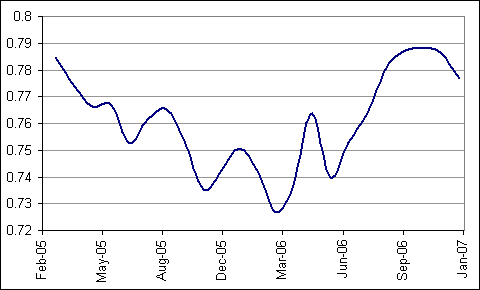
Looks like I’m going to be losing money as the USD suddenly strengthens right after I buy the AUD!!!
Like I’ve mentioned before, I don’t have much faith in the US dollar. Here’s an article I read today that supports the theory. Enjoy…
Nothing fails like success.
As recently as a half-century ago, the American stood like a colossus in a New World…young, free, healthy; and a creditor to the rest of the world, which owed him not only money…but liberty, for he had lent his muscle, his oil, his manufacturers – and even risked his life to win World War II for the Allies.
“What can be added to the happiness of a man who is in health, out of debt, and has a clear conscience?” asked Adam Smith.
Here at The Daily Reckoning headquarters, we too are occasionally beset with bouts of debt-free happiness. But we count on our natural gloominess to get us through.
But…what about people who have more debt than any one else…whose health suffers from too much sustenance…and whose conscience is encumbered with a bloody war made on people they didn’t even know, for a purpose no one knows? Can they expect happiness?
As to their conscience and health, we have no opinion. But as to their debt we have many.
Fallen into our hands is a report from the CIA, ranking nations in order of their current account balance. The current account, we remind readers, is like the operating statement of a business or an individual. Income must exceed outflow or your upkeep is your downfall. The difference between what comes in and what goes out, if it is positive, accumulates as though it were a profit. If it is negative, it builds up – but not necessarily, in the form of debt.
So what do we see? The country with the best position is Japan – with a current account balance of plus $165 billion. China is in the number two position, with almost as much. And here we pause to give readers a chance to gasp. China – a country run by communists – has the second best current account balance in the world. Figure that. In other words, Marxism…at least as practiced in the Middle Kingdom…has proven no bar whatever to capitalist success.
But we will move on…
Germany is the third most ‘profitable’ country in the world – with a positive current account balance of $115 billion. Then the list goes into various oil producers, watchmakers, and assorted national curiosities…such as Algeria…with – would you believe it – has an $18 billion surplus! Even tiny Hong Kong ended last year nearly $20 billion to the good.
But between Swaziland and the Comoros (which, we believe is an island nation somewhere off the coast of Africa) the figures make the kind of transformation that can only be likened, in the material world, to going from light to darkness, or in the sentient world, from life to death. That is, they go from positive to negative. The numbers which were such a comfort to Germany and such a delight to Japan become an embarrassment.
Poor Burkina Faso, perhaps the most God-forsaken hole on the surface of the whole planet, suffers a $438 million deficit and still manages to hold its head up in public.
“Hey, wait a minute,” said a friend at a dinner party recently, “Burkina Faso is not so bad. My wife and I love to go there for desert trekking. There is nothing there…no restaurants…no hotels you’d want to go to…no theatres…not much of anything. But out there in the natural world… in the desert, there is a quality that is sublime. I wish I could describe it to you…but you have to see it for yourself.”
That said, at least Burkina Faso is far from the worst on the CIA’s list. The rest of Africa follows…and then come the Banana Republics of Latin America…and finally, guess who makes the end of the line-up? Guess who has the worst current account deficits in the entire world? Guess which countries spend more than they earn – regularly and spectacularly?
Last in line are the nations of the Anglo-Saxon, English-speaking debt-based empire! New Zealand has a deficit of nearly $10 billion. Then, South Africa…and India…and Australia all have deficits too. Among the major former colonies of the British Empire, only Canada seems to have any sense. It runs a surplus. The others are all debtors. The UK itself is third from the bottom with a $57 billion negative current account balance.
For no reason we can think of, the penultimate on the list is Spain. And then comes the worst of all…the United States of America, with a current account balance of a minus $829 billion.
Add up all the deficits of the entire world and you get a figure barely half of the U.S. total.
The U.S. economy makes up a quarter of the world total…that it should have more than half of the world’s current account deficits is a spectacular success – only made possible by its great wealth and status.
And here, in yesterday’s news, comes the latest: “Record $68 billion trade deficit in July,” reports Bloomberg.
Nothing fails like success.
If you’d like to check out the facts for yourself, go to the CIA Factbook. [The CIA can’t be wrong about this. After all, didn’t they provide irrefutable evidence that Saddam had weapons of mass destruction! 😉 ]
Just got my hands on
Getting Rich In America: Eight Simple Rules for Building a Fortune–And a Satisfying Life by Dwight R. Lee and Richard B. McKenzie.
It picks up where The Millionaire Next Door left off.
The books is broken down into 8 steps that are easy to read and follow. You know, work hard, learn compound interest, get an education, get married and stay married etc. Nothing you already didn’t know. However, the authors do a great job explaining the math behind each decision you make in life. Every little expense you make today can have a tremendous ripple effect in the future.
The first chapter is essentially motivational and says that if you work hard, take personal responsibility for your wealth[or lack thereof] and quit complaining, you can become rich.
The authors go into considerable detail giving examples of how someone who makes minimum wage can retire in style. Various salary, returns and durations are calculated and the answers are quite eye-opening. Effects of excessive consumption are also calculated. Not buying a new car every 3 years and instead buying a used car can make your retirement $840,000 richer!!!! Similarly the costs of buying regular coffee instead of a fancy latte can help you be $74,000 richer in retirement. Not only do they provide the examples, but they also explain how to get the answers in excel or on a financial calculator. Pretty Neat!
All in all, I like it. It didn’t change my life, but its good to read these books once in a while. I strongly recommend it as a gift to your young kids,neices or nephews in high schools, or people about to get married or divorced or mid-way through life…..ok, basically its for everyone!
I give it 2 thumbs up.
Since I own investment property in Indiana, it makes sense to follow whats happening there.
The Indy Star just had an article on ballooning property taxes.
Basically the assessors office is changing the way property is being assessed which is likely raise the average tax bill by 15%. That sucks! Taxes on my property are already at 2.2%. I’m not keen on paying any more than that.
Yet another reason I prefer SLC over other regions in the country. Its tax rate is only 0.7%, a lot lower than Texas’s 2.8% and definitely a lot lower than New York and New Jersey where its over 5%.
To the unsuspecting Californian who assumes that its 1.2% all over the country, that can turn into a nasty shock. As always, do you homework before you invest anywhere.